FreeCell Solitaire Online
Play FreeCell with all 52 cards visible, four free cells for temporary storage, and no stock to draw from. Move every card to the four foundations, building each suit from Ace to King. The board above is ready to play without a download or account; use Undo to explore a different move.
How this FreeCell game works
The deck is dealt face up into eight columns: seven cards in each of the first four columns and six in each of the other four. Seeing a card does not mean you can pick it up on its own. Cards farther down its column must be moved first, or form a legal sequence that can move with it.
- Tableau: build down one rank, alternating red and black. A black 8 can go on a red 9.
- Free cells: each holds one card. Move an exposed bottom card into an empty cell, then bring it back into play when you have a legal destination.
- Empty columns: accept any single card or an ordered sequence within your moving limit. You do not need a King.
- Foundations: start with an Ace, then add the next rank of the same suit. For example, only the 3 of Hearts can follow the 2 of Hearts.
- Sequences: every card from the one you select to the bottom of its column must descend by one and alternate color. Your empty cells and columns limit how many can move together.
A three-card move, step by step
This example is a simplified position, not a preview of your current deal.
Why do two empty cells matter? You could make the same move one card at a time: park the 6 and 7 in separate free cells, move the 8 onto the 9, then put the 7 on the 8 and the 6 on the 7. Dragging the run performs that rearrangement as one action.
Why a run fits one destination but not another
This game calculates your moving limit as (empty free cells + 1) × 2spare empty columns. Count only columns that are empty before the move. If you are moving into an empty column, leave that destination out of the count: it cannot also serve as temporary storage.
| Empty columns before moving | Destination | Maximum run |
|---|---|---|
| None | An occupied column | 3 cards |
| One | An occupied column | 6 cards |
| One | That empty column | 3 cards |
Suppose you have two empty cells and one empty column, and want to move an 8 of Spades, 7 of Hearts, 6 of Clubs, and 5 of Diamonds. The four-card run fits onto an exposed 9 of Diamonds because the empty column helps you rearrange it. It does not fit into your only empty column: that destination leaves no spare column, so the limit drops to three.
Before filling a free cell, identify how you will release its card. With no empty columns, filling your last free cell reduces your moving limit from two cards to one. An apparently helpful move can therefore prevent the sequence move you planned next.
Choose your destination with the controls
- Drag and drop when you want a specific destination. For a sequence, drag its highest card; the cards below it must form a valid run.
- Click or tap an exposed card to let the game try a foundation first, then a tableau column, then an empty free cell. It chooses a legal destination, so use dragging when the choice matters.
- Hint points out an available move. It does not solve the whole deal or guarantee that the suggested move is your best option.
- Undo reverses a move so you can try another approach. Cards already sent to foundations cannot be dragged back; use Undo to reverse that action.
- New Game starts a fresh deal. A normal shuffled deal is not guaranteed to be solvable.
Common questions
Why can I see a card but not move it into a free cell?
A free cell takes only one card. If other cards overlap the one you want, move those out of the way first. A whole sequence cannot be parked in a single free cell.
Why does my correctly ordered sequence snap back?
Check both the destination's rank and color, then count your spare space using the moving-limit examples. A valid sequence can still be too long for that destination.
Is every FreeCell deal winnable?
No. This game's ordinary deals are shuffled without a promise of a solution. Published results for specific numbered deal sets also do not measure a player's chance of winning; our FreeCell winnability guide explains the distinction.
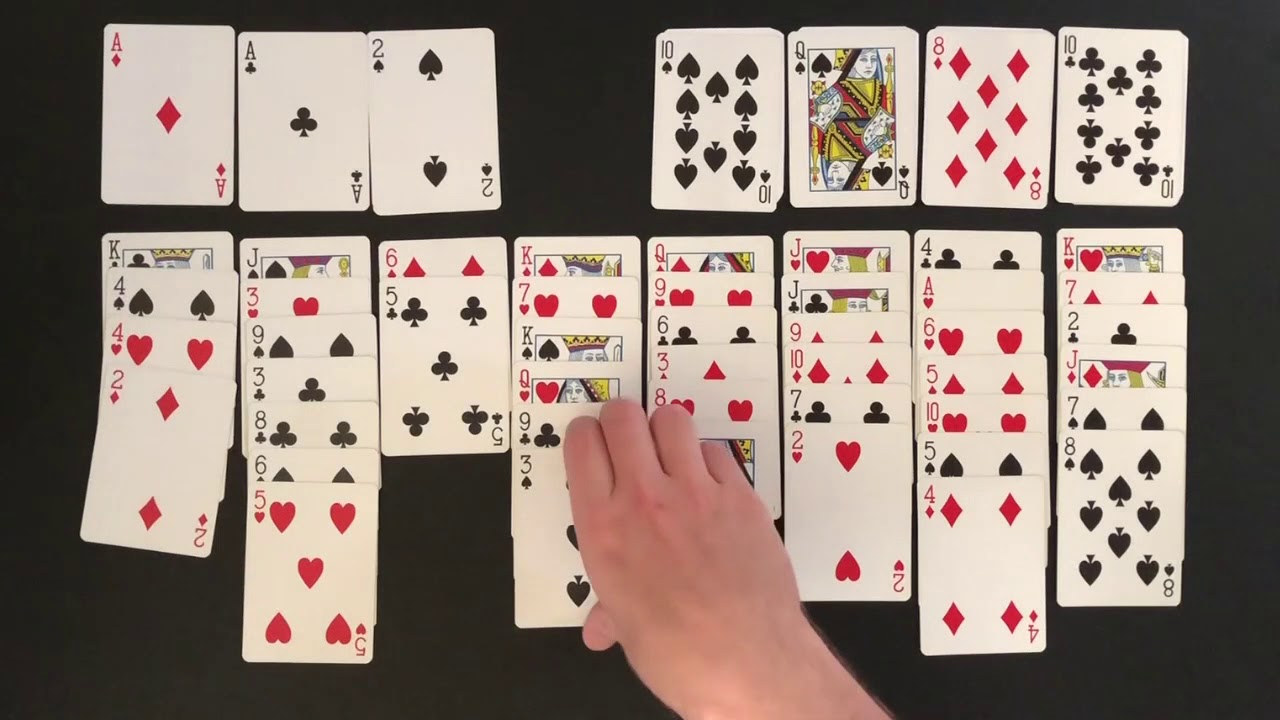
Watch a FreeCell tutorial
Try a different kind of planning
Spider Solitaire lets you build with any suit, but moving a whole run requires matching suits: see the mixed-suit move example. Klondike Solitaire adds hidden cards and a draw pile. For a tile puzzle where your choice changes what becomes accessible, try Mahjong's pair-choice examples before playing the board above that guide.
Want a different card game? Play one of these!

Klondike Solitaire (Classic)
The timeless solitaire card game. Build tableau stacks in descending rank with alternating colors and move cards to the foundations by suit from Ace to King. Ideal for quick sessions and classic gameplay fans.
Play KlondikeSpider Solitaire
A deep, strategic solitaire card game played with two decks. Build same–suit sequences from King to Ace across 10 columns. Try One Suit, Two Suits, or Four Suits difficulty for increasing challenge.
Play SpiderMahjong Solitaire
Remove pairs of free tiles from a layered layout. Ordinary tiles must match exactly, while Seasons and Flowers can be paired within their respective groups.
Play Mahjong


